


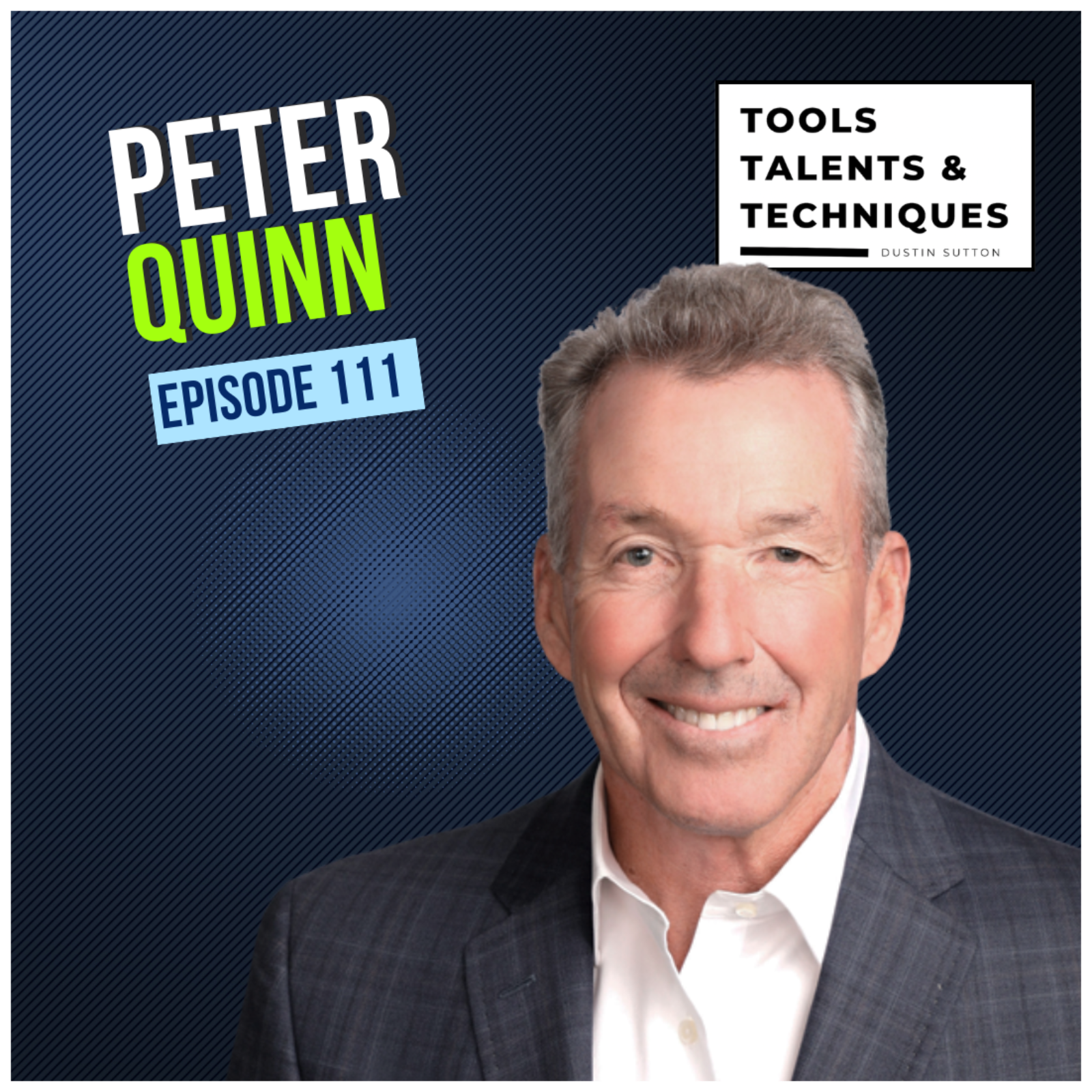
The Commercial Real Estate Fundamentals That Never Change | Peter Quinn of Kidder Matthews | Ep. 111
Commercial real estate has changed dramatically over the decades. The fundamentals that drive success in it have not.
In this episode, Dustin sits down with Peter Quinn, a veteran broker at Kidder Matthews whose career spans IBM sales training, land development, and some of the most dynamic market cycles San Diego has ever seen. Peter brings a perspective you can only earn through real experience over real time.
The conversation covers how Peter made the pivot from IBM into CRE, what that sales foundation taught him about building trust, and why the advisor mindset separates long-term producers from short-term players. Peter also gets honest about resilience, sharing what it actually looked like to navigate the hard seasons and come out still standing.
You will also hear Peter break down the tools and systems he uses today, why CRM is non-negotiable for anyone serious about building a real estate business, and how staying informed through consistent reading gives you a consistent edge in any market.
Whether you are early in your CRE career or a seasoned operator looking to sharpen your edge, this episode delivers the kind of insight that only comes from decades in the field.
What You Will Learn
How Peter transitioned from IBM into commercial real estate and what that pivot taught him
Why the fundamentals of sales and relationship building never go out of style
How to act as a trusted advisor rather than just a transaction broker
Why CRM is non-negotiable for anyone serious about building a real estate business
How resilience through market cycles separates long-term producers from short-term players
Why staying informed through reading gives you a consistent edge in any market






Here are the full optimized RSS show notes:
Peter Quinn has seen commercial real estate from every angle. IBM sales training, land development, market crashes, and the digital transformation reshaping how deals get done today. Through all of it one thing has remained constant. The fundamentals work if you work them.
In Episode 111, Dustin sits down with Peter Quinn of Kidder Matthews to unpack a career built on resilience, relationship building, and a relentless commitment to staying sharp in one of the most dynamic industries in the world. If you are building a career in commercial real estate or trying to navigate a market that never stops moving, this conversation is exactly what you need to hear.
🔑 Key Topics Covered
From IBM to Commercial Real Estate
- How Peter's sales training at IBM shaped his approach to CRE
- What the pivot from tech to real estate taught him about transferable skills
- Why cold calling and fundamentals still matter in a digital world
Building Relationships and Acting as a Trusted Advisor
- Why the best CRE professionals lead with advice not transactions
- How to navigate client relationships and manage expectations effectively
- The role of trusted networks like Provisors in building a sustainable business
Tools and Technology in Modern CRE
- The tools and apps Peter uses to stay ahead in today's market
- Why CRM is non-negotiable for serious real estate professionals
- How staying informed through consistent reading creates a consistent edge
Land Development and Market Trends
- Navigating land development opportunities in the San Diego market
- How resilience through market cycles separates long term producers
- What Peter sees coming in the future of commercial real estate
Lessons from the Advertising Business
- How a background in advertising sharpened Peter's communication skills
- The crossover between marketing thinking and real estate strategy
- Why self discovery and resilience go hand in hand in any career
💡 Key Takeaways
- The fundamentals of sales and relationship building never go out of style
- Acting as a trusted advisor rather than a transaction broker builds a career that lasts
- CRM is not optional for anyone serious about building a real estate business
- Resilience through market cycles is what separates long term producers from short term players
- Continuous learning and staying informed give you a consistent edge in any market
- Transferable skills from outside the industry are often the biggest competitive advantages inside it
🔗 Resources Mentioned
- Provisors Network: https://www.provisors.com/
- Kidder Matthews: https://www.kidder.com/
🔗 Connect with Peter Quinn
- LinkedIn: https://www.linkedin.com/in/peterquinn/
- Website: https://www.kidder.com/
Podcast Homepage: toolstalentstechniques.com
#CommercialRealEstate #LandDevelopment #Resilience #SanDiego #the3tpod
Peter Quinn (0:00): There continues to be innovation, solutions, shortages in our economy. Some are gonna be very difficult to bring to market. The whole data center push now is real and it's gonna suck up a lot of money. And if artificial intelligence continues to be a factor in our lives, and I believe it will be, I think there will be great opportunities to take the knowledge and the relationships that we both developed and use those to the benefit of the clients that need that unartificial intelligence response analysis.
Dustin Sutton (0:54): All right. So Peter, you got the experience little countdown on Riverside, but here we are at Tools, Talents and Techniques. And this this episode has been a long time coming. I'm very happy to welcome to the show, mister Peter Quinn. I've known Peter for, I don't know, wanna seven years now or something like that.
Dustin Sutton (1:11): And through commercial real estate and, you know, just his experience in brokerage and just seeing all the ebbs and flows of the industries. This has been a conversation that I've been looking forward to. So, Mr. Peter Quinn, welcome to the show.
Peter Quinn (1:24): Dustin, thank you very much. Thank you for having me. This is an honor and a pleasure to be here.
Unknown Speaker (1:29): All right. So I know I gave a little bit of an intro, but could you give a thumbnail of who you are and what it is that you do?
Peter Quinn (1:36): Sure. Love to do that. Sort of a San Diego guy. Went to college here at San Diego State, graduated, and was hired by IBM. Supposed to be hired here in San Diego, but they didn't have any openings.
Peter Quinn (1:49): So I got hired in Orange County, which was fantastic because it was a much more competitive environment to learn business practices. And working for IBM was like going to graduate school. I mean, it was fantastic. And after three years, all of my really good buddies in the IBM Xerox background environment, you know, great sales training, and they were all leaving to go into commercial real estate. And honest to God, I I knew how to spell commercial real estate, but that was about as much as I knew about it.
Peter Quinn (2:19): And I made the decision that I was going to interview with as many companies as I could, but I really only wanted to get hired by what was called then Coldwell Banker Commercials now called CBRE. I had several friends over there and it just looked like the kind of a platform that would allow me to meet my goals and objectives. And it did. I mean, it was fantastic. Spent five years at the Newport Beach office of CB, which was at the time the highest earnings per producer of any CB office in the country.
Peter Quinn (2:53): The environment was extraordinarily tough. I mean, my best competitors were in the cube next to me and, you know, we weren't stealing from each other, but you know, you were careful about what you said out loud because we were all going after a lot of the same things, but it was a great environment. I got recruited away to come back to San Diego and become a development partner with a company that had spun off from National Trammell Crow Company. And that was again, an extraordinary learning opportunity. I thought I knew a lot about commercial real estate when I left brokerage to go into development.
Peter Quinn (3:29): My God. I mean, I knew nothing. Yeah. You and I have talked a lot about different aspects of the real estate business and I've seen you come in and out of opportunities as you saw ways to improve your knowledge level. And it's, it's amazing what you can learn from people who have experience if you're willing to pay attention.
Peter Quinn (3:50): And I know that's an attribute that you embrace.
Unknown Speaker (3:52): Well, thank you. I appreciate that. I try, I try to learn that's a big part of this podcast too. I get to interview people that everybody sees the world through their own lens and their own experience. And so there's a lot to be gleaned off of what other people have seen and done.
Unknown Speaker (4:07): So thank you. I appreciate that. And yeah, sometimes I'm like, I don't know what's behind that curtain, but I'm going to find out and I'm going to learn as much as I can. And hopefully that benefits me and those around me as well. But before, before we go further into that, I want to talk about, you know, the, the beginning, because you mentioned in school, then you went to IBM.
Dustin Sutton (4:28): Was business something that you majored in or something that you wanted to do?
Peter Quinn (4:32): Yeah, it's funny. I started out in accounting and I was good at accounting. It was just so incredibly boring. And San Diego State had and still has an amazing business school. And I flipped to finance and it was amazing to me how much I use those tools at IBM.
Peter Quinn (4:52): And then it was even more analytical when I got into the commercial brokerage and development business because it's all about the numbers. You know, there's only so much manipulation that you could make to a, you know, a computer or a big copier product. I mean, they set the pricing in White Plains, New York and go get them, you know, go sell where, and I think you see it as well. Walking into the office in a commercial brokerage environment or in my development company, I really don't have any idea what I'm gonna do. There are three things that I'm going to get done today, but then there's going to be 10 other things that I hadn't anticipated and it makes it so fun.
Peter Quinn (5:36): I mean, it's just like, my God, I can't wait to get in to see if it's going to happen today. So I think that that attributes to be able to learn from others, with others. And there are a number of young men and women that I've talked to over the years about what they want to do when they get out of college or how they want to pivot to their next career. I'm learning stuff from those people. I mean, they're teaching me ways in different ways in which I can look at the world and be a better communicator or a better analyst or just a resource.
Peter Quinn (6:13): And again, I'm, I mean, I share that, I hope with you because I see what you do out there and it's, it just builds confidence in people when you're able to be that good ear, listen more than talk.
Dustin Sutton (6:26): Yeah. Well, also it's very refreshing. I think it's great for people to hear that you've been in this business forty years. Right. Am I, am I, I don't want to undersell it right.
Unknown Speaker (6:36): Or oversell it, but
Unknown Speaker (6:37): you're right.
Dustin Sutton (6:37): Okay. That's, that's almost half a century in this business. And for to hear you say, I'm still learning, I'm still listening. I'm still growing. That is a trait, a quality that I think we can all, we'd all need to have in our life.
Unknown Speaker (6:54): So that that's great to hear.
Peter Quinn (6:55): Yeah. I mean, you miss so much if you're not paying attention and if you're not out seeking a different way of doing things. And as we get deeper into this broadcast, I know we'll both be sharing some things that we're seeing that are going to dramatically impact the way in which we communicate and continue to be problem solvers for our clients.
Dustin Sutton (7:14): Okay. I want to, I want to make sure because you are a, you know, a fountain of knowledge from your experience and your journey. Let's go back to IBM real quick though, because your accounting, you know, finance, okay. You go into IBM and it's sales. And it's, you know, especially what I know from Xerox and what I know of IBM and I worked at a company called Cintas, which has its own sales training.
Unknown Speaker (7:41): And so it's not easy. So what, what was that like? Just going into that and being like, oh, okay. Was it, I like this, this is hard, but I like it. And this is for me.
Peter Quinn (7:51): Well, you know, I was naive enough to think that I was going to be chairman of the board in, you know, twenty five years after I started there right out of college. But I went to IBM because I knew I would get good training and I knew that I wanted and needed that. And so the first, you know, six or nine months you're training, you know, twenty fourseven, it's just all about understanding the product. It's understanding the ethos at IBM, white shirts, polished shoes, you know, no cocktails at lunch. You could get your client a cocktail, but we could do a cocktail.
Peter Quinn (8:25): And I had a territory in Orange County and I literally walked every block. I went into every storefront and I did it over and over and over again. I would see some people 10 times before they finally go, okay. All right. I'll buy that.
Peter Quinn (8:45): And so that was, I mean, that's a great experience for anybody getting 25 nos before you get a yes or a maybe, and being able to walk out with a smile on your face. You know, if you do it enough, you will be successful. But it's it's hard. It's not for everybody. That's for sure.
Peter Quinn (9:06): But that set the table for being a a willing sponge in the commercial real estate brokerage environment because there are some gotta use all those skills, but you're now applying them in a much different and creative way. And as you can imagine, forty years ago, we did not have much technology. So, I mean, it's a way different experience than what we're able to corral these days. But I, you know, I would come back into the office after a day of driving industrial marketplaces, which is what I focused on in Orange County. And I would give the tape to my, the pool secretary and she would look at me and her eyes would roll and go, oh my God, another tape.
Peter Quinn (9:56): And she would tape all of the, you know, Northeast Corner Of Orange And Catella. And, you know, I just did that every vacant piece of land I cataloged for the entire county that I could find. I'm sure I missed a lot of things, but, and I just worked it called and met and, you know, made those presentations and got busy.
Dustin Sutton (10:18): The feeling that I have from you saying that is a little bit a mix of like PTSD and a joy because I've been through that same exact experience, but it's like those cold calls and doing all that. But like, you're right. You get good at it. Not necessarily numb to it, but it just becomes part of how you are. So that's cool that to hear you talk about that that origin story.
Unknown Speaker (10:47): Wow. Weird.
Peter Quinn (10:48): Yeah. I mean, in the whole, you know, cold calling thing, when you go from a fixed territory, I mean, nobody could sell on my territory. I was selling against Xerox and Burroughs and, you know, folks like that. But in commercial real estate, I mean, there's no there's no territory. There's just you getting out and grinding it.
Peter Quinn (11:09): And and you have to be really adept at making the contact, keeping a record, following back up. And that was all done manually when I first started. Yeah. And if you did that, you're gonna make a lot of money and have fun doing it. If you don't do that, now we've got CRMs and all kinds of reminders that can keep us on track, which of course I'm fully embracing all of that help because it's necessary to compete in today's environment.
Dustin Sutton (11:41): Yeah. So having the, having the fundamentals though, like learning the hard way and doing all those things. I was just at a conference where they were talking about artificial intelligence and all these things and, you know, people about getting jobs and like where all this is going, but the fundamentals still remain like the persistence, the the ability to understand what you're talking about and how you, how you really embrace what it is you're trying to learn and how you document all, all those things like the tools just, you know, kind of accelerate that in a way and speed it up. But the fact that people, have to get in and do the work to actually understand it is key. It's crucial.
Peter Quinn (12:24): Well, and as you know, when you get comfortable doing that, it lowers the barrier with your customer. You know, they start to think and believe that, you know, I'm I'm really here just to advise you. I'm not selling anything. I'm gonna listen to what it is you think you need to grow your business, expand your production, reach new markets. And I'm gonna take that back with me often.
Peter Quinn (12:47): I'll share that with my colleagues, you know, met with so and so today they're in this particular vertical business. And I see some real opportunities to expand there. Let's go dive not only after this client, but let's go after this sector and see if we can go make a difference. And that's been really, powerful as well.
Dustin Sutton (13:07): So one of the things in commercial real estate and most of the folks that are gonna listen to this and watch this, a lot of them are in commercial real estate. And you mentioned being an industrial, like how was that something that you were like, okay, I'm gonna do this because this is the opportunity. Did were there other product types that you were interested in? Like what, what was your journey as far as figuring out which lane of brokerage you wanted to, you wanted to be in and stay in?
Peter Quinn (13:33): Yeah. '19 let's call it 1983, a little more than forty years. Development environment in Orange County was as dynamic a market as you could possibly see. That were ten years old built in the, the Irvine Industrial Complex, which included the cities of Santa Ana, Tustin, Irvine. I mean, they were tearing down ten year old buildings and replacing industrial buildings and replacing them with higher bay manufacturing of what was going to become an emerging sector, R and D and office.
Peter Quinn (14:12): And, and there was a ton of land still available. So that to me looked like the low hanging fruit. Understand who the owners of those properties were. And some were, you know, the professional organizations like the Irvine company or the Mission Viejo Company. But there were a lot of guys that came out of the cubes five years before I got there who were teaming up with institutional investors like Copley, the development arm of New England Life Insurance.
Peter Quinn (14:42): And they were they were making a lot of money and making a lot of headway. All probably believed that this will never end. Of course, 1989 showed up and it ended pretty dramatically. By then I was a partner with this company called McLaughlin Investment of the Trammell Crow spinoff. And that was a tough time.
Peter Quinn (15:08): I literally had to start over in '90 to form my own company to become an advisor to corporations. So I was really back in my brokerage mentality. I'm looking for people that have a problem. I'm just trying to help them solve. And then we did some syndications.
Peter Quinn (15:28): Two of my McLaughlin partners joined me, did third party management and being constantly in the space, we were able to develop a really good reputation and survived that very difficult period in commercial real estate from '89 to '95. Stay alive to '95. It was what we came into the office every day saying.
Dustin Sutton (15:49): So you mentioned something else about the relationships that you build with people over time. I would love to, especially when you talk about being an advisor and listening to people and figuring out what they're really trying to accomplish. And when you do that, you definitely get to a different level of a relationship with someone. Tell me about the through line through your career and what that means. Cause when you're an advisor to somebody, maybe they have a need now and then they find their space or they find their property.
Dustin Sutton (16:20): You know, they probably don't need you right away. Maybe they do want to buy another property. Like how does that weave into your, your life story?
Peter Quinn (16:27): It is a factor. You know, you only control what you control. And if I have a relationship with a company and I I don't find the solution for whatever reason and somebody else does, well, you know, good on them. You know, the clients need support from wherever they can get it. I don't often lose clients, but you know, it happens.
Peter Quinn (16:48): Sometimes I compete for business. I've done business in San Diego in particular with a really successful nonprofit. And I've been doing all their business in North County for the last ten years. I've done, like, five transactions, and each transaction has forced me to go beyond what I what at the time I thought was comfortable. It was like, oh my God, they're asking for so much.
Peter Quinn (17:11): And this, this is gonna be so hard. This owner is gonna be so angry with me. And every time that they push me, we were able to combine, get the best deal in the market. So I mean, by a margin. I mean, we were I leased some 60,000 feet in North County, San Diego at, I think it was 81¢ a square foot in a market that was a buck and a quarter.
Peter Quinn (17:38): I mean, it was amazing. It was a sublease, so we got a little lucky, but you you hang around the rim, you get lucky once in a while.
Unknown Speaker (17:47): That's right. You gotta be there. The big part of it is showing up and being present. That's right. And like you said, paying attention,
Peter Quinn (17:54): paying attention. I'm spending a lot of time the last couple of years, on identifying owners of real estate that has reached its functional obsolescence. So it's no longer a viable farm. It's no longer a viable 30 year old industrial building. It's no longer a seven acre family estate in Coastal Encinitas where the families that established that, the people that established that are no longer here.
Peter Quinn (18:22): And they left three kids hopefully with a well planned out of state so that that property can be sold and proceeds distributed. So I spent a lot of time trying to understand what people have done and what they haven't done. And you and I are part of a group called provisors, which I think we pride ourselves in being, you know, open to bringing as many resources into a conversation to make sure the client's being well served. So we're doing that. Our team is identifying these baby boomers.
Peter Quinn (18:56): Now, hi, mister and missus Sutton. It's really great to meet you again. And we've talked about your property. I just wanna make sure that some of the pieces that you're gonna need to allow me to transact are in place or updated. So, you know, how's what's the condition of your trust?
Peter Quinn (19:14): Well, you don't have a trust. Well, I have a couple of people I'd like you to talk to. You got your will done. When was the last time you updated it? Okay.
Peter Quinn (19:22): So we need to get that done. You know, you had a farming operation here. I might suggest we come in and do a quick environmental assessment so that we make sure that we're not trying to dispose of something that may need to be cleaned up. And so once those pieces are in place, however many there are, then I can actually put a plan together to help them, you know, unlock the equity that's in their property, mostly through sales, but often through development, if they're willing to wait the amount of time that a development takes to mature. But it's mostly just disposing of the asset and making sure that the heirs have reasonable expectations and that we over perform.
Peter Quinn (20:02): So that's been fun.
Dustin Sutton (20:04): And you mentioned provisors and assembling that team that's around you. And I'll call it a team because there's one thing that, you know, when you look at things holistically, it's not just the real estate or the property. It's all those other things that you mentioned that, you know, the trust and, you know, the environmental assessment. Who have you found are the best people to surround yourself as, as you're going out there in the field? Who who's the, what are the types of people are do you have at your side when you're going out there?
Unknown Speaker (20:39): Or is it is it any more than just that than the trust attorney?
Peter Quinn (20:42): Covering you know, really covering all the bases. I mean, I have a handful of real estate attorneys and my first counsel to either a tenant or a landowner or buyer for that matter who wants to transact is, I know you have a great business attorney, Dustin, and I know you've got a great estate attorney, and we've talked about that before. But real estate is a animal into itself. You must have somebody that actually understands what the current law is, that they understand the document that we're gonna be working with. I use the AIR document a lot for leasing and for sales.
Peter Quinn (21:25): And an attorney who understands that documents can get their review done in an hour. Somebody that doesn't understand that document is gonna bill the client ten hours. Well, that's, that's a waste of time and money. So it's sometimes hard asking the client, please don't use your business attorney, please. I know he's your cousin or your nephew or whatever, but don't do it.
Peter Quinn (21:49): So there's that element. I had a civil engineering crews that, that have been unbelievably beneficial to helping me understand what's possible. Who else? Property management firms are so important to the process. They often have that first relationship that we need support on.
Peter Quinn (22:09): Then we happen to have property management internal here at Kitter Matthews. So I'm going to them for, well, who are you using for janitorial? What does it cost to clean an office building per square foot per month these days? You know, if it's a class A facility versus a class C facility. You know, who is the go to environmental engineering firm for these kinds of projects?
Peter Quinn (22:33): Because farmland and industrial properties are gonna be far different than a legacy office building or a retail center. And they're not likely gonna have the kinds of problems unless of course you have a dry cleaner in your project. That was a problem. I don't think it's much of a problem these days. So yeah, it's, I mean, my Rolodex to use an old term is chock full of folks that I know can help me and they will come when I ask as they know I will for them.
Peter Quinn (23:06): So that's a huge benefit. Improvisors contain so many of those pieces that it just makes it a more powerful advocate and ally for me as I hope I am to them.
Dustin Sutton (23:18): Yeah, that's amazing. And then going back to the relationship piece of it, there are so many, when you get into the, into the nitty gritty, we start to peel back of anything. There's so much nuance. There's so many things. And so even like you said, for commercial real estate, you know, there's class a, there's class B, class C, there's all, there's all these things.
Dustin Sutton (23:38): And then there's, you know, office versus industrial and everything has its own, you know, special spice to it. And there, there, there are certain things that you need to know, and there are different rates and different, you know, vendors that need to be involved. One thing that I've learned a lot from provisors and being in and watching how the attorneys operate, Because to your point, people say, oh, I know, I know somebody who's an attorney. It's like, you know, family law is different than criminal law versus, you know, business law versus real estate law. There's so many different shades of it.
Dustin Sutton (24:10): To see people like, oh yeah, I'm just going to go to this attorney. The way the provisors really showed me in the attorneys is that the best referrals are from people that are in your same industry, but they just specialize in that thing. I was like, that's, that's amazing. And they're not just clamoring over whatever deal. It's like, what deal makes sense?
Dustin Sutton (24:29): Like what opportunity, what client, what person that I can help makes the best sense. And everybody is really giving each other pitches to hit, you know, it's like, oh no, this is right across my plate. Send it, send it to me. This goes right across his plate. Send it to him.
Dustin Sutton (24:44): It's been fantastic to see, and it's a win win win. Like everybody wins. The client wins, You know, the owners, business owners win. The the reps win. Everybody wins.
Unknown Speaker (24:53): It's pretty it's pretty special.
Peter Quinn (24:54): Yeah. I've had certain attorneys because Providers is an attorney rich environment. Attorneys that I brought a deal to and they've said, you know, I'm just not gonna be the right fit. I understand what it is they wanna do, but, you know, you really should call so and so. I mean, this is exactly what they do.
Peter Quinn (25:12): You know, it could be, you know, a boundary adjustment. So we know the attorney that does boundary adjustments and it's a. It's it's people are not afraid to walk away from business if they really feel that there's a better solution you know, in their sphere of influence.
Dustin Sutton (25:29): Yeah. It goes a long way with, especially with clients that come to you and they, and you say, well, yeah, I could do this, but the better person and they, it builds trust too. Cause they go, wow, you're not just after a buck. You're actually here at like you initially said to be an advisor to help get that person to the solution. So and then over the years, as you're meeting more, more and more interesting situations where you're like, I've never seen this before.
Unknown Speaker (25:53): I'll find out. And then you learn and then you find somebody else that's in your, in your Rolodex now, and you develop that relationship. It's pretty, pretty cool. I like it.
Peter Quinn (26:02): The most valuable three words are, I don't know. And I'll find out.
Unknown Speaker (26:07): And I'll find out. That's right. That's right.
Peter Quinn (26:09): Because we all know people that, you know, have experience in some of the weird, odd things that we come across. So yeah, I agree.
Unknown Speaker (26:17): So you also mentioned the tools that you use that the year and the show being tools, talents, and techniques. Let's talk about the tools. Cause over the years when you first started probably Thomas brother guides.
Peter Quinn (26:28): Absolutely. Year, buy a new Thomas Brother Guide.
Dustin Sutton (26:32): Yeah. So flash forward a few decades. So what are the things now that you're using in your toolkit, whether it's your CRM and like doing your research, like what, what are the things that you use?
Peter Quinn (26:44): Well, I use organizations, title companies in places that are warehouses of critical data. And I am using artificial intelligence every day now very carefully. You know, I, I don't publish stuff with AI. I just do research and then go back and check and make sure that what answers it gave me are valid and supportable and have some sort of a reference point that you can point back to. But simple tools, like I have a tool on my phone.
Peter Quinn (27:19): It's not a Google Earth. It just allows you to put in an address and then it will go right to that address with an aerial photograph, give you all the ownership information on your phone, very readable. If, if you are physically on the property and you drive the perimeter, it will actually show you driving the perimeter in real time so that you could say, oh yeah, that's exactly where that property line is. And I got that from a client. He just said, have you seen this before?
Peter Quinn (27:48): I go, no.
Unknown Speaker (27:49): What's the name of the app?
Unknown Speaker (27:51): OnPoint. And I'll send you a link to it. Thank you. It gets really cool.
Unknown Speaker (27:56): All right. Well, I'll share with the audience too. I'll put it in the show notes. Unofficial. They're not a sponsor of the show, but maybe you'll know, we'll see.
Peter Quinn (28:03): CRM is very important. Integrating with a team, getting everybody on board on that. That's, that's always a difficult process to go through unless you parachute into an organization like yours. I've suspected Meisner has a CRM that they would like everybody to use and it allows people to communicate in between divisions. That's important stuff because you never know when you wanna take a couple of days off, you need a little coverage.
Peter Quinn (28:30): And having people that have access to that kind of data is very important. And then I track every single deal that I have any possibility of bringing across the finish line. Everything starts out 1%. At the end of the year, you gotta true up, what do we actually get across the line and what did we? But it keeps me on task.
Peter Quinn (28:56): Okay, where do I need to spend time? These four deals are at 25%. There's a chance to get them over the line this year if we focus our time and attention. Some things you can't control. I do a lot of land projects and those are twenty four to thirty two month escrows.
Peter Quinn (29:14): So they're gonna have a timeline of their own that you can't force. But yeah, and I read a ton. I read all day, every day I'm reading.
Dustin Sutton (29:23): I was gonna bring that up because I remember there the first time that was the first time but but a few years ago, we're we're meeting we're I think we're having lunch. Actually, we're having Thai food for lunch. I remember. And you were talking about what you what you read in the paper. And then you mentioned something else that you read.
Dustin Sutton (29:42): Then later you mentioned something else that you read. I was like, that's a lot like where you are. Tell me about that process. Like how, when did that start? Is it like the paper every morning?
Dustin Sutton (29:51): Are there specific papers that you read? What's what's where's the data coming from that you're ingesting?
Peter Quinn (29:56): Today, it's actually a lot different than it was then. So then I was reading the local paper just to make sure I was staying in tune with what's going on locally. I read the sports. And then I read the Wall Street Journal. I try to read that every day, but sometimes I've gotta catch up.
Peter Quinn (30:13): You know, I get three days in on a Saturday. And then I follow a number of digital broadcasts. Globe Street is a great resource for people in the real estate industry. The daily transcript was a great resource. I haven't really followed their emerging new ownership, see if that's as powerful as it used to be.
Peter Quinn (30:34): And then I have a digital support team that helps me identify subject matter that is, you know, if not directly in on the periphery of things that I'm concentrating my business on. And they send me a couple of articles every day And they they they give me a suggested paragraph to lead with and then a link to the article. So I'll click on the article, read that, go to the summary, make it to the adjustments I need, send it back. They send it out to LinkedIn, Instagram, TikTok, and it along with continuing to update my own profile keeps my Google score up enough that if people who are watching this, if they go on to Google and type in commercial real estate San Diego, I will certainly be in the top five. I'll probably be the top one.
Peter Quinn (31:32): And the business that comes in or the leads that come in off of that, most of the time, they're really not something I can do, but I can be of service to that person. I don't do any commercial real estate. I can't help you with that condo. No residential real estate. I can't help you with that condo or that's, you know, that's retail.
Peter Quinn (31:51): And I'll let me introduce you to one of my partners. And it's been super helpful in terms of, again, getting people to talk about what I'm doing and getting people comfortable. I mean, the provisor network has been fantastic. I've got a dozen people that follow all my posts and, and then, you know, they're thinking about me when something comes up around land. I mean, I hope that's what people, cling onto because that's what I love to work on.
Unknown Speaker (32:22): So yeah.
Dustin Sutton (32:22): Well, that's mental real estate, right? I mean, you got the, you're working in the physical real estate, you got your digital online real estate, and then you're staying in people's mental real estate. So yeah, man, that's all the way Exactly.
Unknown Speaker (32:36): That's exactly right. It's a great way to put it.
Dustin Sutton (32:38): Yeah. Man. So, okay. So you mentioned land, right? And in California, there's that.
Dustin Sutton (32:47): I mean, there's plenty of land in California, but is that really what you're, why you're focusing on the properties that are near obsolescence lots being obsolete. That's yes.
Peter Quinn (32:59): Yeah. It's it's you know, it used to be when I was with CB up in Newport, it was vacant lots and master plan industrial communities. Right? So pretty easy. You just go get a brochure at the Irvine Company office and here's what I have to sell.
Peter Quinn (33:15): Now it's I see vacant land every place. And former partners of mine, we left the development company, unbelievably smart guys. But, you know, they just said to me, you know, there's no future in this development stuff. And there's not enough greenfield opportunities, greenfield meaning undeveloped sites. And I said, I just, I think it's different.
Peter Quinn (33:41): You just gotta look at it differently. And it's a little bit harder to look at a building that has outlived its useful life to understand what could possibly go there. But if you're paying attention, if you're reading a lot, you know, you're gonna go, well, that's gonna be a 10 story apartment building in five years. I mean, it just is that gas station no longer has a place on this corner. And so I stay in touch with those ownerships and occasionally I stumble onto a deal where I know a particular product type developer is very interested in marketplace.
Peter Quinn (34:18): If I've been paying attention, then I can typically find a deal or two that will match that investor developer's appetite.
Unknown Speaker (34:27): So over the years, there's been a lot of valleys and peaks and the great recession. You mentioned '89, 2007 to '8,
Unknown Speaker (34:38): 2001.
Dustin Sutton (34:39): 2001. Of all the things that was there ever a time where you were like, I want to do something else or maybe I'll try or go to a different location that's not Southern California thought like this is the end of commercial real estate, I don't want to do this anymore. Are we just always all in?
Peter Quinn (34:56): That's a great question. And it has a couple of different answers to it. So we in '9, as the market was imploding, we had developed an office building in Serrano Mesa and we were having a hard time filling it up. So we built out an executive suite operation and we knew going into that, that this was a loss leader. Executive suite operations don't survive HQ.
Peter Quinn (35:24): I mean, I think Regis has done a really good job, but I don't understand their model because I know how the model works. But we had a whole bunch of really interesting tenants in this executive suite. One of them was a software developer and we were always there till 07:00 at night. So he would, you know, stumble out of his little corner of the executive suite, come into our office and, you know, shoot the shit. And so he came in one day with a, I didn't even know what it was, but it was a tablet.
Peter Quinn (35:54): It was Steve jobs tablet. They called it NeXT. And Steve Jobs' idea was that this is gonna be the new utility information tracker. Metermaid would use it to go, okay, we checked off Quinn's house. We checked off Sutton's house, or it might be used by property management companies.
Peter Quinn (36:12): And we had a property management company. So we're always looking for ways of reducing our costs. And he built a great graphical user interface. It was really, really good. Very easy to use.
Peter Quinn (36:23): No customers. So we didn't invest in that deal. And he came back about a year later, or maybe not even that, and said, I have an idea of putting internet access kiosk in public places. And so would you guys be interested in just watching what I'm doing? And if it looks exciting, I'll go racing my party.
Peter Quinn (36:44): So he did it and we built a model and a retrospect, I was unfortunate enough to know the communications director for Hilton Hotels Worldwide. He was golf with my in laws. And I talked about it to him. He goes, that sounds really cool. Let me see if I can get you in a few of our hotels.
Peter Quinn (37:04): We did a big demo up in Burbank and they said, yeah, let's go. So we had to basically take their direction on where to go, which was a huge mistake As we needed to be like in Southern California, that was it. But we were in Atlanta, New York, Dallas, Scottsdale, San Diego, LA, San Francisco, Seattle. I mean, we're we had 13 units out. Everyone had the same mechanics to it, but everyone looked different because it had to match the decor of the hotel.
Peter Quinn (37:41): We, it was, was a mess. So we, that did not work. And I'm, I'm gonna try to make this a short story as I can, because it, but it is kind of interesting. I'm sitting in my office. We have shut the company down, brought all of our equipment back from these hotels.
Peter Quinn (37:57): It was successful in their environments. We just couldn't service it. And that brought up a footprint. And so 07:30 at night, phone rings. Guy goes, hi.
Peter Quinn (38:07): Is Peter Quinn there? I go, this is Peter Quinn. Guy goes, yeah. My name is Arnie Leap. I'm with a company called, Computer Concepts out of New York, Long Island, actually.
Peter Quinn (38:19): And I wanna talk to you about your product, Infone. That was the name of our company, I n f o n e. And I said, my eyes just rolled back in my head. I'm glad we didn't have FaceTime then. I said, you know, okay, what would you like to know?
Peter Quinn (38:36): Well, I'd like to know if you'd be interested in licensing your software. And I said, look at, there are five companies that are doing this in The United States. Four of them are in your backyard. Like three of them, almost in Toronto. Go talk to, you know, Blue Ridge, go talk to, you know, whatever the names of the firms were.
Peter Quinn (38:54): He goes, well, I've actually been to all four of those headquarters and they don't have anything. I mean, they've got a little gerbil on a wheel making those things work when he took the top off of their device. And he goes, but I was down in Atlanta and I logged onto your device. I established an internet connection. I got an email address.
Peter Quinn (39:18): It printed out a card for me and gave it to me. And I got a receipt for, you know, discount on coffee at the coffee shop in the Hilton hotel. I go, so now I'm going on now. What do I do? I said, well, okay.
Peter Quinn (39:33): Would you like to come out? He goes, yeah, I would like to, I go, well, fantastic. When would you like to come? I'll see you at your office at nine tomorrow morning. So he hasn't left New York yet.
Peter Quinn (39:43): It's now 09:00 in San Diego. And he was at our office at 09:00. And in two weeks we signed a licensing agreement. I got them to pay us enough money to pay off all of our vendor debt. And I wound up joining them for eighteen months in New York to launch a company called Mallnet, which was taking basically everything we had done and putting it into this amazing piece of sculpture that David Rockwell David Rockwell is an architect in New York who did Detroit Baseball Stadium, that did Atlanta's Baseball Stadium, was the architect for Cirque du Soleil troops all over the world.
Peter Quinn (40:29): This guy was freaking brilliant. And so we wound up, you know, raising a bunch of money. Jack Welch was on our board of advisors.
Unknown Speaker (40:38): Wow.
Peter Quinn (40:39): Jim Cannavino was second in charge of IBM, was part of our board of advisors, a bunch of different characters, bunch of wild characters. And it was very fun. Our target was the regional malls. I met every regional mall owner in the world. If they did not come to New York or Las Vegas for ICSC, I went to see them and they just wanted too much.
Peter Quinn (41:05): So, yeah, you went inside my mall and that'll cost you a million bucks. And then you put in all the money to put the machines in. And then this is $992,000. There was no wifi. So, well, how am I gonna get from the server room to these twelve three sided, you know, beautifully architected.
Peter Quinn (41:30): And well, we're gonna have to jackhammer up the travertine. Until at that point, I told the guys, none of whom are real estate fellows, this is not gonna work. We cannot pay a million dollars, jack up the travertine, make it look as pretty as it was. It's just not gonna happen. And I wound up leaving the company in like May 2000.
Peter Quinn (41:51): And then we installed a completely operating system at a brand new mall in Nashville. It was the Opry Mills Center and they did a fantastic job, but just wasn't scalable. Need five more years, five more years we would have had Wi Fi and it would have been a huge success.
Dustin Sutton (42:11): And during this time, because that's a lot to go on to go into this business and move to the other side of the country and do all those things. But you're also you're also learning, I'm sure, like, through the
Peter Quinn (42:23): My dogs might learn I mean, it was basically the advertising business, which I had never been in. So we were meeting with, you know, the the biggest dogs in the kennel. Apollo was, you know, making huge investments in advertising platforms. I mean, they were they're the ones that basically control all the huge billboards in Times Square. Blackstone was coming into the business and we had a, we had a shot and we been five years later of being able to control a piece of that business, but it's hard.
Unknown Speaker (42:55): Yeah. Hard.
Unknown Speaker (42:57): You control time. Yeah. It's fun. You learn. Yeah.
Unknown Speaker (43:01): Then so, okay. So with all the experience that you had in real estate, and then you had this opportunity and you look at you go for it, you're you're doing these things When you came back to real estate, because did you go right back to real estate after that?
Peter Quinn (43:16): Actually, came back and started a company called eBuilding Solutions and eBuilding was providing internet access to commercial customers who cannot get a DSL connection. DSL was distributed by the, you know, whoever the local provider was, Cox, PacBell, AT and T. And there were certain marketplaces, Sorrento Valley, much of Torrey Pines, you couldn't get a decent internet connection. So we had operations in Northern California, Central California, LA, and San Diego. And then I would fly around to the major phone companies trying to understand where are you guys in this process?
Peter Quinn (44:04): When are you going to put me out of business? Everybody indicated that they just didn't have a solution for it. It wasn't anything they were spending any time on. We're trying to service the customers that we can get to. And these people that you're serving, we can't get to.
Peter Quinn (44:19): So I did that for a couple of years, resigned from my real estate company, sold my partnership interest to my two partners, worked on this thing. And, you know, we broke even, but I didn't take a paycheck for a couple of years. And it got sort of to the point where we couldn't scale. We couldn't acquire all of the technology we needed to actually grow in our marketplace because we were successful wherever we got in the door. Yeah, of course I could use an internet connection.
Peter Quinn (44:50): Everybody needs one now. And it was at that time that a development company at Orange County found me and asked me to come on and be their development partner here in San Diego. So I did that for five years until you know, mid two thousand seven where our chairman said, you know, I've seen this movie and, this is not gonna end well. So we're gonna shut down San Diego, Arizona, Reno, and Northern California. And so we shut down those divisions of I was in charge of the San Diego division.
Peter Quinn (45:29): And I went back into servicing my corporate clients. So it was a pretty easy pivot, but it was a pretty hard time, not a lot of activity from 2008 to ten, but wound up doing some really interesting business, helping a convenience store operator redeveloped and or develop a gas station convenience stores in Oregon and Washington.
Dustin Sutton (45:54): So, and I want to make sure we save a couple of minutes to talk about where you see things going. But when you talk about your career and your journey and these experiences, you know, you mentioned the research and like how you do things. When you, when you think about all these things, is there a through line that you realized about your, your talent, your proficiency, like who you are as a person that maybe you realize now that you didn't realize at the beginning?
Unknown Speaker (46:26): You know, there's the
Unknown Speaker (46:27): I mean, that's kind of a wide question. I know that's kind of wide, but like, as you're saying these things, and that's one thing I love about having these conversations of being able to take chances. And even though they're hard, hard things happen, but you, you grow from, did you, have you learned anything about yourself throughout all this?
Peter Quinn (46:46): That I am amazingly resilient and that I'm really good at hiding, you know, what's actually going on in my brain. Cause there were times when I was like, I just went, wow, this is, this is so hard. I'm not exactly sure how I'm gonna navigate this thing. I don't, I don't have, you know, I have not experienced this particular thing. So what am I gonna do?
Peter Quinn (47:10): Well, I'm gonna get up every day and I'm gonna make phone calls and I'm gonna continue talking to my pals that, are some of whom are also trying to figure out what the heck's going on. And but it's yeah, there, there have been some very rugged episodes where I did not have answer and getting up with a smile on my face and going out there and stirring it up, you know, has been really my savior. And my wife has been an incredible partner, you know, through that process. So it's it's just don't give it up. I mean, I know what I can do and I've I continue to to do the things that I've I know how to do and like to do.
Peter Quinn (47:51): So I always had that to fall back on. Markets do have to cooperate, but there was opportunity again where people that I had grown up in the business with looked at the Southern California landscape and said, there's no more development here. I mean, you know, we're done. And probably for this type of things we were doing, maybe there wasn't as much opportunity to build master plan industrial communities, but that building over there is gonna come down and we're gonna buy that thing and we're gonna design something beautiful. That's gonna have much higher rental income opportunities.
Peter Quinn (48:29): We'll maybe hold that if we're lucky, sell it and make a profit and go do it again.
Dustin Sutton (48:36): Being resilient and understanding that it will, I'm not putting words in your mouth, but the way I'm, I'm experiencing this, you understand like, Hey, there's gonna be good times, bad times, but there's always gonna be more times that happens. Just, you'll figure it out. You gotta, you gotta be resilient and flexible. I
Unknown Speaker (48:54): mean, you and I got families. They like to eat.
Unknown Speaker (48:57): Yeah, that's right.
Unknown Speaker (48:58): They're going to expensive schools. I mean, what the heck?
Unknown Speaker (49:00): Yeah. So before we take off where, where do you see real estate going? What's next in this industry? Like what, what are you excited about in this industry?
Peter Quinn (49:11): Well, as there continues to be innovation solutions to shortages in our economy, some are gonna be very difficult to bring to market. I mean, the whole data center push now is real and it's gonna suck up a lot of money. And if artificial intelligence continues to be a factor in our lives, and I believe it will be, I think there will be great opportunities to take the knowledge and the relationships that we both developed and use those to the benefit of the clients that need that unartificial intelligence response analysis. People are gonna go rent spaces using the internet. They're not gonna need a broker for that more than likely in five years.
Peter Quinn (50:00): But selling somebody an investment project or or taking their pride and joy and saying, okay, we're gonna turn, you know, this greenhouse operation into, know, you 150, affordable houses and it's gonna rock. I think we're a long way away from having a machine, you know, give you that sort of, feedback. Maybe not forever, but I think it's gonna be well. All right.
Dustin Sutton (50:27): So thank you very much for being a guest. Before we take off Peter, I want to say thank you for your time and everything that you've done, like just being able to have these conversations over time and just, you know, just being a being a friend and being a colleague. So I I appreciate the time. Any parting thoughts you wanna give? Like, where people can find you, where they can or, of course, Google.
Unknown Speaker (50:49): All you gotta do is search commercial real estate San Diego.
Peter Quinn (50:52): Estate San Diego. You'll find me, I think. Well, I'm with Kitter Matthews here in San Diego. Kitter is the largest independently owned private commercial real estate company, West Of The Rockies. We have 900 professionals at the service of our clients.
Peter Quinn (51:07): It's a fantastic environment for me to work in because I get to work with people that are both younger and older, some with less experience and more experience that I can gain benefit from and hopefully add some value to. And you know, it's just a fun place to do business. I'm so lucky to live in San Diego. Not everybody gets to do that. And I think just reach out to me anytime.
Peter Quinn (51:38): Any of you have any question about commercial real estate, I may not have the answer, but Dustin will.
Unknown Speaker (51:46): All right. Peter Quinn, thank you very much.
Peter Quinn (51:48): You bet, Dustin. Take care, buddy.